



Spaceman Strategy: Mathematical Framework and Tactical Analysis for 2026
Creator:
Pragmatic Play
Type:
Slot
Variance:
Moderate
Theoretical RTP:
96.5%
Min Bet:
1
Largest Bet:
100
Hands-Free Spin:
No
Release Date:
24.03.2022
The strategic analysis of Spaceman requires honest engagement with one mathematical reality: every cashout strategy operates against a 4.5% house edge embedded in the 95.5% theoretical RTP. No tactical framework eliminates this disadvantage. What strategy can do is structure session variance, optimize the relationship between win frequency and win magnitude, and impose discipline that protects bankroll integrity. The framework below documents the analytical approach applied by experienced crash-game participants and is offered without any guarantee of profitability.
Probabilistic Reality: The Limits of Spaceman Strategy
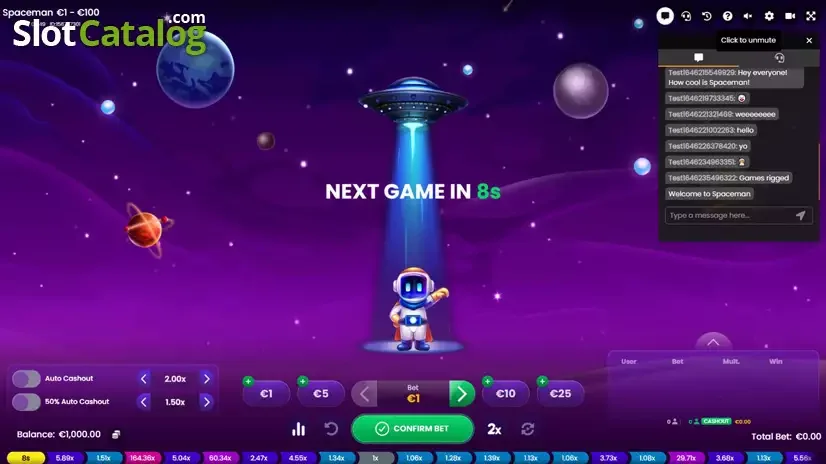
The fundamental statistical proposition of Spaceman is straightforward. The theoretical RTP of 95.5% implies an expected long-run loss of C$4.50 for every C$100 wagered. Across 10,000 wagered units, the expected loss is C$450. This figure is not negotiable through cashout timing; the RNG produces independent, mathematically unpredictable outcomes regardless of the participant's prior round results.
The implications for strategic thinking are significant. No "system" exists to overcome the house edge. No pattern in past crash points predicts future ones; the gambler's fallacy is a documented cognitive distortion that the RNG architecture renders inoperative. The only legitimate strategic objectives are: structuring variance to match risk tolerance, imposing bankroll discipline that prevents catastrophic loss, and selecting operational parameters that align with personal entertainment goals rather than profit objectives.
| Total Wagered | Expected Loss (95.5% RTP) | Expected Loss (96.5% RTP) |
|---|---|---|
| C$100 | C$4.50 | C$3.50 |
| C$1,000 | C$45.00 | C$35.00 |
| C$10,000 | C$450.00 | C$350.00 |
| C$100,000 | C$4,500.00 | C$3,500.00 |
Mathematical Foundation: RTP, Probability, and the Empirical Crash Range

The Spaceman cashout decision is mathematically isomorphic to a constrained optimization problem: select an exit multiplier that maximizes expected value subject to the participant's risk tolerance and the underlying RNG distribution. The game is engineered by Pragmatic Play on HTML5 architecture and operates identically across desktop and mobile platforms; strategic frameworks transfer cleanly between devices. Eligibility for AGCO/iGaming Ontario licensed Spaceman play requires verified participants aged 19 and over, with KYC documentation completed prior to withdrawal under FINTRAC and AGCO requirements.
Translating 95.5% RTP into Session Reality
Across 100 rounds at C$1.00 stake each, the expected return is C$95.50 — a structural loss of C$4.50. The standard deviation of this outcome is substantial; the 95% confidence interval at this volume spans approximately C$50–C$140. Players experiencing variance outside this band should not infer game malfunction; the dispersion is consistent with the medium volatility classification.
Empirical Crash Range from Independent Simulation
Slotsjudge's proprietary simulator, executing 10,000 spins per day, reports observed crashes predominantly within the 1.35x to 500x range. The median crash is approximately 2.0x. Approximately 30% of crashes occur below 1.5x; approximately 50% occur below 2.0x; approximately 90% occur below 10x. These distributions inform the strategic frameworks below. The mathematical independence of crash outcomes is enforced by Spaceman's Provably Fair RNG, which generates each round via a verifiable server-seed/client-seed/nonce hash; participants may audit the cryptographic data via the post-round result strip. Independence verification is a foundational assumption of any strategic framework.
Maximum Win Probability Analysis
The 5,000x outcome — producing C$500,000 on a C$100 stake — represents a tail event with empirical probability approximating 1 in 50,000+ rounds. At sustained gameplay of 60 rounds per hour, this probability translates to approximately one occurrence per 800+ hours of active play. Strategic frameworks should not presume this outcome within reasonable session expectations.
Strategy Framework One: Conservative Auto Cashout at 1.5x to 2.0x
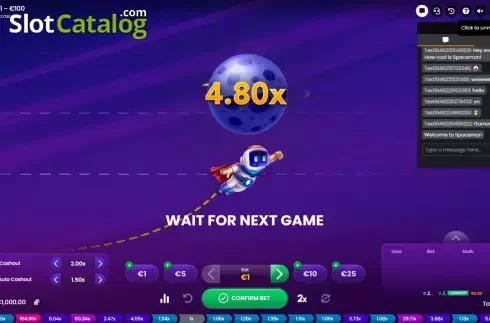
The conservative framework targets high hit-frequency with low win-magnitude. Auto Cashout is configured at 1.5x or 2.0x; the rationale is that approximately 50–60% of rounds reach this threshold, producing modest but frequent return.
The mathematical profile: at 2.0x Auto Cashout, the empirical hit rate observed in simulation is approximately 50%. A C$1 wager at this configuration produces a per-round expected value of approximately -C$0.045 (consistent with the 4.5% house edge), with high session-level consistency. The variance is structurally minimized; sessions rarely deviate dramatically from the expected loss curve.
Use case: participants prioritizing extended session duration with limited variance exposure. The framework is poorly suited for participants seeking significant single-round returns; the 2.0x cap structurally eliminates large-multiplier outcomes.
Strategy Framework Two: Balanced 50% Cashout at 2.0x with Manual Hold to 5.0x

This framework leverages Spaceman's distinctive 50% Cashout mechanic to construct a hedged position. The structure: configure Auto 50% Cashout at 2.0x, retain remaining stake for manual cashout at a higher target such as 5.0x.
Numerical Example
Consider a C$10 stake with this configuration. At 2.0x, Auto 50% Cashout executes, locking C$10 of value (the original stake breakeven). The remaining C$5 of position continues. If the participant cashes out the remaining position manually at 5.0x, the total payout is C$10 (locked) + C$25 (remaining at 5.0x) = C$35. If the round crashes between 2.0x and 5.0x, the total payout is C$10 (locked); the participant retains the original stake but realizes no profit.
Variance Analysis
The hedged structure dramatically reduces downside variance compared to manual-only strategies. The participant's worst-case scenario above 2.0x is breakeven; the upside extends to the configured manual cashout target. This profile is not present in Aviator or JetX, neither of which provides 50% Cashout functionality.
Use case: intermediate participants comfortable with decision-making under time pressure who seek upside exposure with structural downside protection.
Strategy Framework Three: High-Variance Manual Cashout for 10x and Above

The high-variance framework targets 10x, 50x, or 100x+ multipliers via manual cashout, accepting that the empirical hit rate at these targets is below 10%, often substantially so. Cashouts at 10x occur in approximately 8% of rounds; cashouts at 50x occur in approximately 1.5% of rounds.
The mathematical profile: 10x cashout strategy produces approximately 8% session win rate with 10x return per win. The expected value remains negative (consistent with house edge), but variance is substantially elevated. Participants must absorb extended losing streaks of 12+ consecutive losses without strategic deviation.
Critical bankroll requirement: this framework is appropriate only for participants whose bankroll permits 25+ consecutive losses without affecting financial stability. The framework is fundamentally unsuitable for participants in distress, recovery from previous losses, or constrained financial circumstances.
Bankroll Management Framework for Canadian Players (CAD)
Bankroll discipline is the strongest available defense against accelerated loss in any negative-expectation game. The framework below is consistent with best practices documented by responsible gambling research organizations.
The 1% Rule
Maximum bet per round should not exceed 1% of total bankroll. A C$500 bankroll permits a maximum bet of C$5 per round, providing capacity to absorb 100+ consecutive losses without depletion. This rule is non-negotiable for participants seeking session sustainability; deviation invariably accelerates loss.
Stop-Loss and Win-Goal Configuration
Pre-session configuration of stop-loss (-20% of session bankroll) and win-goal (+30% of session bankroll) imposes objective exit triggers. AGCO-licensed Canadian operators provide deposit limit tools that enforce these parameters at the account level, removing dependence on participant willpower at moments of cognitive distress.
Session Time Limits
Spaceman's pacing produces approximately 60 rounds per hour at active play. Sessions exceeding 30–45 minutes correlate with degraded decision quality. A self-imposed 30-minute cap is recommended; participants who experience difficulty observing this cap should consider it a signal of problematic engagement and consult the responsible gambling resources documented later.
Five Strategic Errors Common Among Spaceman Participants
Patterns of suboptimal decision-making have been observed across crash-game player communities. Each is documented below with the corrective measure.
Doubling Bets to Recover Losses (Martingale)
The Martingale system fails catastrophically against the 4.5% house edge. Any extended losing streak — statistically inevitable across sufficient round count — produces wagering amounts exceeding most reasonable bankrolls. The strategy is documented as a primary contributor to bankroll destruction in crash-game communities.
Believing Past Crashes Predict Future Ones
The RNG produces independent outcomes. No correlation exists between consecutive round results. The gambler's fallacy — the conviction that a "due" outcome is more likely — is empirically false and constitutes one of the most documented cognitive distortions in gambling psychology.
Skipping Demo Mode Validation
Strategy frameworks should be validated in demo mode prior to real-money application. Demo mode is functionally identical to real-money play; bypassing this validation step exposes the participant to avoidable variance.
Ignoring Auto Cashout for "Feel"
Manual cashout under round-level time pressure introduces emotional variance into the decision process. Auto Cashout eliminates this variance, executing the strategy as designed.
Continuing After a Significant Loss (Tilt Behavior)
Cognitive degradation following loss is well-documented. A five-minute break following any session loss exceeding 50% of session bankroll is recommended; resumption within this window correlates with accelerated bankroll degradation.
Comparative Strategic Analysis: Spaceman versus Aviator
Aviator (Spribe, 2019) and Spaceman exhibit different strategic profiles despite belonging to the same genre.
| Strategic Dimension | Spaceman | Aviator |
|---|---|---|
| Theoretical RTP | 95.5% / 96.5% | 97.0% |
| 50% Cashout Hedging | Available | Not available |
| Round Pacing | Fast (~25–35 sec) | Slower (~30–60 sec) |
| Decision Latency Tolerance | Lower | Higher |
| Optimal Strategy Profile | Hedged 50% Cashout | Auto Cashout discipline |
Strategic implication: participants whose primary need is reaction-time tolerance select Aviator. Participants whose primary need is structural downside protection during hedged positions select Spaceman. Neither game offers an objective strategic advantage; the selection is a function of personal risk profile.
Drops & Wins Integration: Tournament Strategy Considerations
Pragmatic Play's Drops & Wins promotional structure overlays Spaceman with daily prize pools reaching $5,000, distributed via leaderboard mechanics tied to high-multiplier cashouts. Participants pursuing tournament leaderboard positioning face a strategic trade-off: high-variance manual cashouts at 50x or above generate the largest leaderboard contribution but produce extended losing streaks; conservative Auto Cashout strategies at 1.5x to 2.0x produce stable session economics but rarely register meaningful leaderboard contribution. The analytical recommendation is to separate tournament-pursuit sessions (allocated entertainment budget, accepted variance) from baseline play (disciplined bankroll, conservative cashout). Tournament participation is operator-dependent; participation has been confirmed at BetMGM Casino Ontario and PartyCasino Canada at the time of analysis. Interac e-Transfer remains the standard CAD-denominated funding mechanism across AGCO-licensed operators offering tournament participation.
Responsible Play: Recognizing the Boundary
The most important strategic consideration in any negative-expectation game is the capacity to terminate participation when continued play produces non-trivial harm. The signs and resources documented below should be considered the foundation of any Spaceman engagement.
Warning Signs of Problematic Engagement
The following behaviors indicate a transition from recreational to problematic gambling: pursuing losses with progressively larger bets; concealing the extent or duration of play from family or partners; allocating funds intended for essential expenses to gambling; experiencing persistent intrusive thoughts about gambling outside of session time; and inability to terminate sessions at pre-configured stop-loss thresholds. Any combination of these indicators warrants immediate reduction or cessation of activity and consultation with available support resources.
Free Resources Available in Canada
Canadian residents experiencing concern regarding their gambling behavior have access to no-cost confidential resources. ConnexOntario operates a 24/7 helpline at 1-866-531-2600, providing immediate consultation in English, French, and additional languages on request. PlaySmart.ca, an educational initiative of OLG, provides comprehensive information regarding warning signs and intervention options. My PlayBreak, accessible via OLG.ca, provides binding self-exclusion functionality for participants who require external structure to support cessation. Gambling Therapy and BeGambleAware offer additional international support resources accessible to Canadian residents.
Strategic Frequently Asked Questions
What is the optimal Auto Cashout setting for Spaceman?
No universal optimum exists. Conservative players configure 1.5x–2.0x for high hit frequency; balanced players configure 2.0x with 50% Cashout hedging; high-variance players configure 5x or above. All settings produce the same long-run RTP.
Does the Martingale system work on Spaceman?
No. The Martingale system fails catastrophically against the 4.5% house edge during extended losing streaks. Documented contributor to bankroll destruction.
Can crash points be predicted on Spaceman?
No. The RNG produces independent, cryptographically verifiable outcomes. Pattern-recognition strategies are mathematically unfounded.
Should the 50% Cashout function be active on every round?
For balanced strategies, yes. The hedged structure provides downside protection without limiting upside exposure on the retained position.
What constitutes a safe daily Spaceman budget?
An entertainment budget that, if entirely lost, produces no impact on essential expenses or financial stability. This figure is participant-specific and should be configured via the operator's deposit limit tools.
Are some times of day better for playing Spaceman?
No. The RNG operates identically regardless of time of day, time zone, or operator concurrency. This perception is a documented cognitive distortion.
Is Spaceman strategy different in demo versus real-money mode?
The underlying mechanics and RNG behavior are identical. Strategic frameworks validated in demo mode transfer to real-money play; the only differential is the absence of monetary consequence in demo, which may produce more aggressive cashout decisions than would be optimal under real-money constraints.
Closing Strategic Recommendation
Spaceman strategy operates within a fixed mathematical envelope. No framework eliminates the house edge; no framework guarantees profitability. The strategic value lies in matching variance profile to personal risk tolerance, imposing bankroll discipline that prevents catastrophic loss, and recognizing the boundary between recreational and problematic engagement. Participants experiencing distress should contact ConnexOntario at 1-866-531-2600; the support is free, confidential, and available 24/7. Detailed mobile-specific tactical refinements are documented in the dedicated Spaceman Mobile Guide.